

Grandson of Food has stepped up in the Family of Food kitchen brigade from Sous Chef des Smoothies to Sous Chef de Pâtisserie, so this morning we made some blueberry pancakes using the iSi ThermoWhip. He thinks the whipper is great for pancakes, because it makes them lighter, but it's tricky to get the consistency thin enough to spray without clogging the whipper, yet thick enough to hold all that extra air--or nitrous oxide as the case may be. We use a ratio by weight of one part egg to one part flour to one part milk to make a batter thinner than a typical pancake batter, but thicker than a crepe. For each egg, add 1/4 tsp. baking powder, 1/2 tsp. superfine sugar, a pinch of salt and a dash of vanilla. The amount of batter made with one large egg will yield about four thick 5-inch pancakes.
Don't have a scale? Get a scale! It's much easier than measuring by volume, and modern baking books often give ingredients by weight. If you bake by weight, your recipes will scale up or down more accurately, and you don't have to wash all those measuring utensils. For these pancakes, just put a bowl on the scale, tare the scale, break the eggs into the bowl and note the weight. Hit "tare" to zero the scale, and put in the same weight of flour, hit tare again, and pour in the same weight of milk.
As the Sous Chef de Pâtisserie demonstrates in the photo above, it is important to mix all ingredients thoroughly and get all the lumps out, so that they don't clog the nozzle of the whipper. Observe the manner in which he holds the bowl with his non-whipping hand to make the most of each stroke of his fork. If you've got lumps, you can strain the batter before pouring it into the whipper. We use a one pint ThermoWhip, but the iSi GourmetWhip should work just as well. Charge with two cream cartridges, shaking two or three times after each charge. Heat up a pan or a griddle to medium high heat and lubricate with a little clarified butter or vegetable oil.
Hold the whipper straight upside down, give it one good shake to concentrate the batter at the nozzle end, and release it slowly in a controlled way onto the griddle or pan. If it clogs, try closing and releasing the valve again until the clog clears, or invert it and shake it again.
For blueberry pancakes, toss a few blueberries on the wet batter after spraying it onto the griddle. Flip when browned on the bottom and cook until done. Enjoy with butter and Grade B maple syrup (it has a lot more flavor than Grade A), if desired.
UPDATE: Just to see what would happen, we left some batter in the ThermoWhip overnight and found that it thinned out a bit and was much less likely to clog, and also the pancakes developed larger bubbles to create a somewhat different texture. Both were good, but the original texture was more like a fine sponge while the pancakes from the batter that sat overnight felt airier. A week later the batter preserved in the canister under nitrous oxide was still good and maintained this same texture that it had after sitting overnight. (15 January 2010)
Saturday, January 9, 2010
Grandson of Food's Blueberry Pancakes

Friday, December 4, 2009
Whipper Info
Son of Food posted the following to the "Comments" of the last post. The info is too good to be hidden away there, so I am posting it here on the front page. This information is for a whipper like this one, the iSi Gourmet Whip.
I did figure out my whipper problem from Thanksgiving, I wasn't taking the charger off before spraying. I had never actually seen one of these in action before. A bit of youTube reference revealed the secret. The following information gives us so much more to work with. Thanks, Son of Food!
Just checking in. So what you need to do, first, is be sure the canister isn't filled above the fill line, which should be 16 oz or 500ml for a 1 pt. whipper. I usually mix whatever I'm whipping in a measuring cup to be sure. The liquid shouldn't have lumps that might clog the dispenser, so strain if you're making something like avocado foam.
Attach the lid with a tip attached. Charge the canister by putting a cream cartridge (nitrous oxide) in the charging cylinder and screwing it in place, shake it up, and remove the cylinder. Don't shake too much. It may only need two or three shakes.
You can also make soda in the Gourmet Whip using soda chargers (CO2), but don't use soda chargers for things other than fizzy liquids, or they will create carbonic acid that will impart an undesirable flavor to things other than fizzy drinks.
To dispense the cream, hold the canister upside down, shake once to move the contents down toward the dispensing tip, and push the trigger slowly so you'll have some control over how much comes out. You can change tips once the whipper is charged. If you hold the canister with the tip up, the gas will be released, and the cream will be stuck in the canister, just like with a can of Redi-Whip.
Here's a website with some useful suggestions--
http://www.espumas.at/preparations/en/
There are some good videos as well on starchefs--
http://www.starchefs.com/product_education/iSi/whipper/html/index.shtml
This is an excellent collection of foam recipes in Spanish by Ferran Adrià, some of which appears in English translation on the isi site linked above--
http://www.cookingconcepts.com/PDF/Espumas_elBulli.pdf
This site has a compilation of recipes using hydrocolloids, including many foams that can be prepared in a whipper--
http://blog.khymos.org/tag/isi/
Friday, November 27, 2009
So Thankful
Yesterday's Thanksgiving was delicious. The best part was seeing friends before and family during the big meal. I am so thankful for all of my friends, family, food, and wine that I was blessed to be surrounded with this year.
The Sweet Potato Pecan Pie was a success! The Chantilly Cream with the iSi Gourmet Whip was not. I ended up with cream spatter everywhere and a charger discharged within momnets. After some research on the web, I think I know what I was doing wrong, but I haven't had a successful whip yet. I ended up with a nice cream anyway, thanks to a hand blender and some tenacity. Son of Food, please post a step by step on how to make the whipper work. Maybe with your guidance, next time will go better.
Thursday, July 30, 2009
Gazpacho Foam
Meanwhile, I've been thinking about what he might be able to eat that could offer the taste and aroma and textures of food without ending up in the lungs, and it occurs to me that the answer may not be in bland hospital foods, but at the cutting edge of the culinary arts, in the field of "molecular gastronomy," experimentation with science and food--food that does not even attempt to satisfy hunger, but food for food's sake. The "thickened liquids" that Father of Food has been drinking, after all, are thickened with many of the same hydrocolloids that avantgarde chefs like Ferran Adrià, Grant Achatz, and Wylie Dufresne have been playing with. Perhaps some restaurant critics think that Adrià's espumas and foams that became popular in the mid-1990s are a bit passé, but what could be more ideal for Father of Food than something intensely flavored and without any substantial mass? Of course we'll have to confirm that with his doctors and the speech therapists who work with him on his swallowing, but it seems promising, and it's always fun to learn to make something new.
Foams are typically made from liquids thickened with starch, fat, egg whites, or hydrocolloids like gelatin, agar agar, xanthan, carageenan, and other food stabilizers that may be familiar from processed food labels, but are generally naturally derived from plants or algae. They may be whipped with a blender or in a nitrous oxide cream whipper. A cream whipper like those made by iSi can whip cream to five times its original volume, or around twice the volume of cream whipped with a whisk or an electric mixer. The one that I use is the iSi Thermo Whip, which is also a thermos flask that can keep ingredients hot for three hours or cold for up to eight hours. The contents are protected by the nitrous oxide gas, so they taste and look fresh when dispensed.
While this all seems new and exotic, it is not that hard to make a foam. My first foam was simply mashed potatoes, served hot and whipped lighter than any mashed potatoes I'd ever had. It was perfect as a side dish where I might want the flavor and texture of potatoes without getting filled up on potatoes. It also worked cold as a garnish for a cold cucumber soup.
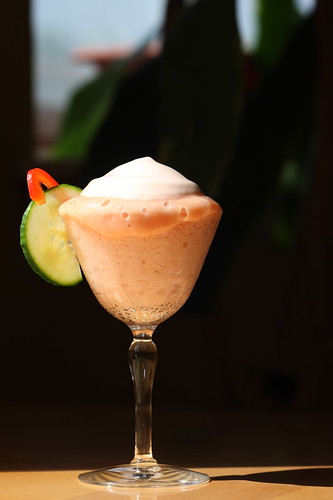
To make the gazpacho foam pictured above, blend at high speed about 1/3 cup chopped onion and one clove garlic with about 1/3 cup beef consommé and the juice of one lemon. Add about 2/3 cup tomato and an equal amount of peeled cucumber and blend thoroughly. Add marjoram, black pepper, sea salt, and piment d’Espelette or other hot pepper or Tabasco to taste. Dissolve 2g Knox gelatin in about 1/4 cup warm beef consommé, and blend into mixture. Strain and chill.
Pour one pint of the mixture into the 1 pint Thermo Whip, charge with one N2O charger, and shake vigorously, then turn the Thermo Whip upside down and shake a couple of times to bring most of the liquid to the spout. Release the foam gently at first to produce a controlled spray. If dispensed at this point, it will be drinkable. For a firmer foam that can be eaten with a spoon, allow Thermo Whip to rest in the refrigerator overnight on its side. Shake vigorously and dispense into a cocktail glass garnished with a cucumber slice and a spear of red bell pepper.


