
 I couldn't resist the quail eggs from Northshire Farms at the Union Square Greenmarket yesterday, so this morning's breakfast, with a little inspiration from Thomas Keller's poached "Bacon and Eggs" from The French Laundry Cookbook, was deviled quail eggs with homemade pancetta. Keller's famous take on bacon and eggs uses poached quail eggs, which was a little more involved than I wanted to be before my first coffee of the day, so hard boiled had to do.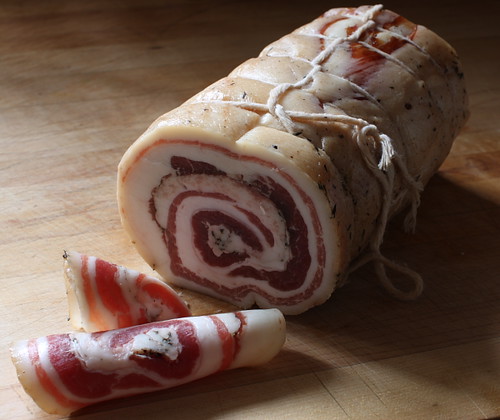
Quail eggs are about an inch long and have speckled shells, and can often be found in Asian markets as well as farmer's markets from time to time. To hard boil quail eggs, put eggs in cold water, bring to a boil, and reduce to a simmer for 3 minutes, then chill in ice water and peel under cold water. The eggs have a surprisingly thick membrane, so the trick to peeling them without breaking the whites is to break the membrane and let a little water in to separate it from the white. It's a little tedious. I'm glad I restrained myself and only bought a dozen quail eggs, even though they were $3 a dozen, $5 for two dozen.
The egg salad is made from the quail egg yolks and whites that broke while peeling, a little mayonnaise, grainy mustard, and a brunoise (a fine dice--about 1/8 inch) of cornichons. I put the extra quail egg salad over cucumber slices. I filled the egg whites with the egg salad using one of grandson of food's baby feeding spoons. He hasn't needed that spoon for over a year, but I knew it would come in handy for something eventually.
The pancetta is diced similarly to the cornichons and then fried like bacon and drained on a paper towel before garnishing the deviled eggs.
Sunday, July 26, 2009
Tiny Deviled Eggs with Pancetta

Tuesday, February 24, 2009
Charcuterie

There is a fine line between a meatloaf and a paté, and there are not many books that can tell you how to stay on the right side of that line, whichever it may be in any particular case. To get a creamy, spreadable paté you need more than an ingredient list, an oven temperature, and a cooking time. It’s all about keeping fat suspended in meat and other ingredients. The technique isn't necessarily difficult, but you need to know it. One of the best books to explain such matters, as well as the methods of making sausage, salami, cured and smoked meat clearly and in sufficient detail for the home cook is Michael Ruhlman and Brian Polcyn’s Charcuterie: The Craft of Salting, Smoking, and Curing

People say “don’t ask what goes into hot dogs, you don’t want to know!” But you really do want to know, don’t you? If you made them yourself, you would know, and you would learn a lot about the hot dogs you buy. Why do some franks plump up and split? They probably have more water. If you try to make a moderately lean frankfurter, like the ones you see sliced in the photo above, along with my variation on fresh saucisson de Toulouse in a choucroute garni, the texture might be denser than you expect of a factory made hot dog, and then you realize that commercial dogs must have a lot more fat or non-meat fillers than you would use if you were making them yourself--that is, if you knew what went into them. Or you might decide you like the texture of a manufactured product, but you want a different flavor, and you could choose what spices or combination of meats to use, the amount of water, and the ratio of fat to lean.
And how about that Toulouse style sausage? The photo at the top shows a dried version of the white sausage in the second photo after it’s been hanging for a week. There is no recipe for either of those sausages inRuhlman and Polcyn’s bookCharcuterie
Thursday, July 17, 2008
Pâté de Campagne

In the cooperative beef purchase I posted about a few weeks ago I got a little over a pound of beef liver that I've been thinking about. Beef liver is kind of intense served straight up, but inspired by the fantastic selection of terrines I saw at Bar Boulud last week (I had the beef cheek terrine), I thought I'd put the beef liver to use in a pâté de campagne. Combined with pork and chicken the strong flavor of the beef liver is just perfect.
I was experimenting and wasn't sure where this was going to go, but here's a rough narrative. Terrines and pâtés are great ways to use all kinds of things in the kitchen that don't fit anywhere else. In other words, don't ask what goes into the terrine, you might not want to know, but really it's not so bad.
Using the fine disk on my Kitchen Aid grinder attachment, I ground a little over a pound of boneless pork rib chops and about the same amount of beef liver into the mixer bowl. Since the pork was a bit lean for this purpose (about a 2:1 ratio of pork to fat is about right), and I was using chicken as well, I also put the raw skin of a whole chicken (I said "don't ask") through the grinder with the pork and liver along with about eight large shallots sautéed with two cloves of garlic. Then I added the spices--about a tablespoon of kosher salt, and a quarter teaspoon each of black peppercorns, allspice, thyme, sage, and a bay leaf ground together using a coffee grinder with a spinning blade, and about three tablespoons of bas Armagnac. For another texture and flavor, I added about half a pound of coarsely chopped crimini mushrooms. I threw in an egg to bind it all together, and mixed thoroughly using the mixer.
So how do you know if the spices are right with something like this? Take a little of the forcemeat and fry it up in some butter. So far so good.
I had some pancetta in the fridge, so I sliced it thin and lined a buttered loaf pan with it, and filled it about halfway with the meat mixture (if I make it in a metal loaf pan instead of an earthenware terrine, does that mean it's really meatloaf?--maybe). Then came the chicken. I had used the breasts for rosemary chicken with asparagus the night before, and the skin went into the grinder with the pork and the liver, so I layered some strips of leg and thigh meat into the pâté, filled the pan with more of the pork and liver, and covered it with a buttered sheet of parchment paper, and then aluminum foil to hold in the moisture.
I had at least a pound of ground meat leftover, so it went into the freezer for another day. I could use it to make this pâté again, or maybe add it to a stuffing for something else. I also had the bones and back of a chicken, so that went into the bag of parts for stock in the freezer. If you cook all the time, everything gets used.
Terrines are usually baked in the oven in a bain marie--a shallow pan of water--so I set my loaf pan in a casserole with water and baked it at 350 degrees F until it reached an internal temperature of 160 degrees F--about 90 minutes. I let it cool for about an hour and meanwhile cut a sheet of cardboard to fit just over the pan, and then weighted it down and refrigerated it overnight.
The terrine made its own layer of aspic, and it's been so hot here in New York that I could just leave the pan out at room temperature for a few minutes before unmolding it, and it came out neatly.
Last night I served it for dinner, garnished with strips of roasted pepper and chopped parsley, cornichons on the side, with slices of toasted Ukrainian rye bread and a mesclun salad. Even Grandson of Food loved it. He's nineteen months old, and he's not interested in a grilled cheese sandwich, but he likes pâté de campagne.


